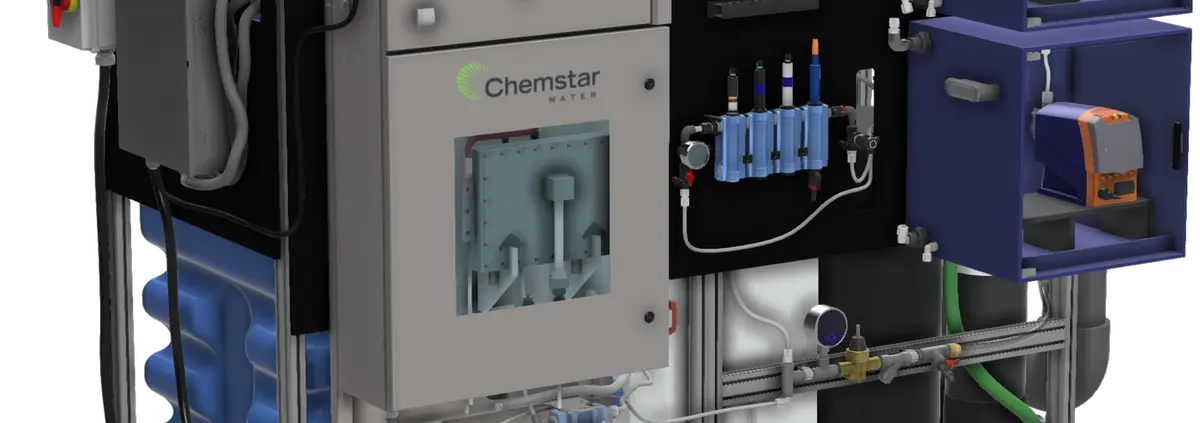
Generate chlorine
where you use it.
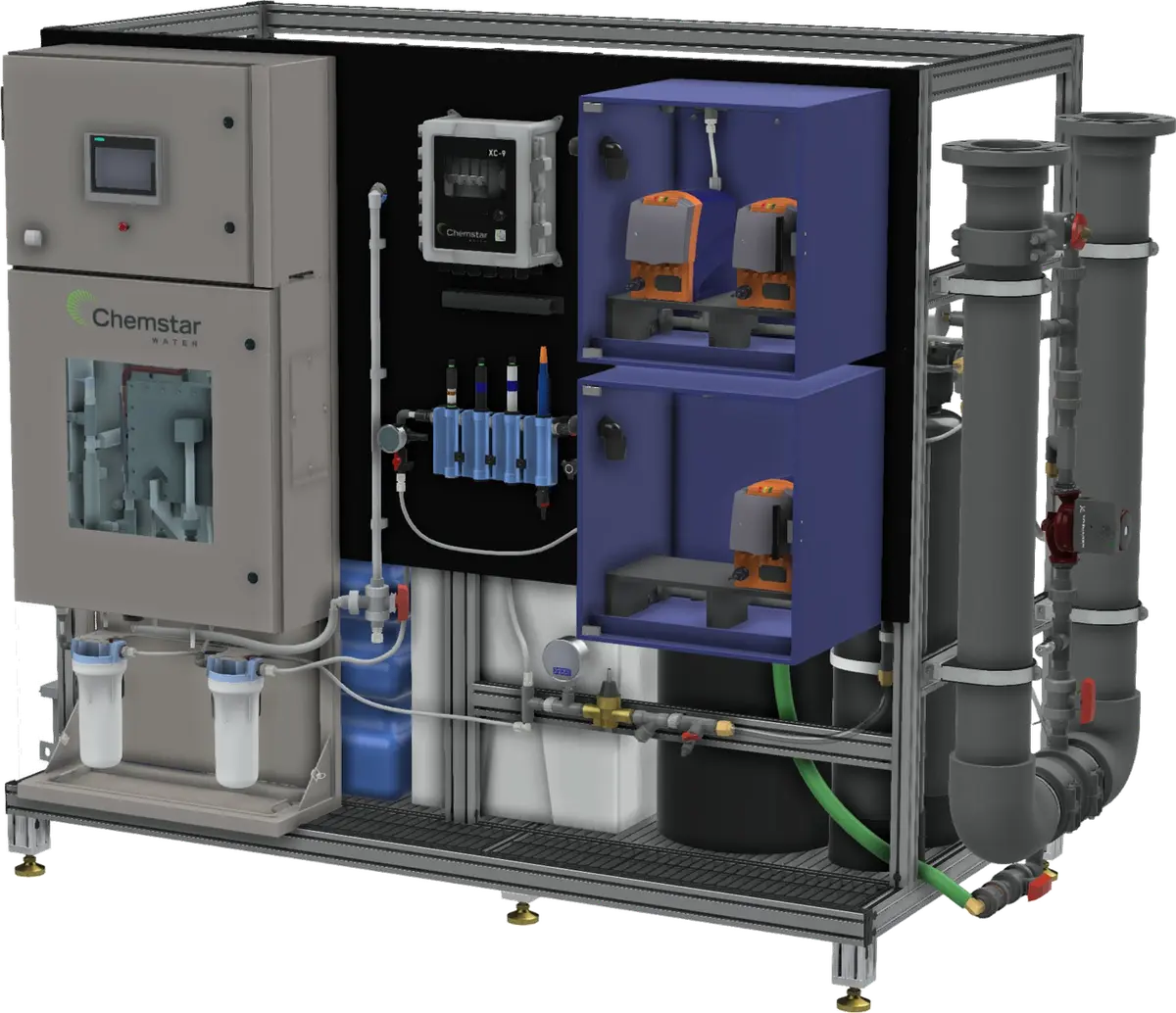
The OX Skid is a fully integrated onsite chlorine generation platform engineered for hyperscale data center cooling. No bulk chemical deliveries, no hazmat storage, no supply chain risk. Your loop sees fresh, on-demand chlorine — produced on the skid, dosed to target, verified in real time.
Two ways to chlorinate a cooling loop.
Only one belongs in a data center.
Every cooling tower needs chlorine to control biofilm and Legionella. The question is where it comes from. Bulk chemical delivery worked when the building was an office tower. At hyperscale, with hazmat regulations, security perimeters, and uptime requirements, it does not.
- ○Scheduled chemical deliveries through your security perimeter, every few weeks, indefinitely.
- ○Bulk sodium hypochlorite degrades in storage. Strength drops up to 30% over 90 days; dosing accuracy drifts with it.
- ○Tank truck logistics, manifest paperwork, and SPCC containment to manage at every site.
- ○Single-vendor supply chain exposure. One disruption, one missed delivery, one biofilm event — heat transfer efficiency drops, condenser approach rises, and your PUE climbs until someone finds the root cause.
- ○Vapor exposure for the operations team. OSHA reporting on every spill.
- ●Chlorine produced on demand from feed water. Always fresh. No degradation, no drift in strength.
- ●Eliminates bulk hazmat storage. No SPCC tank, no manifest tracking.
- ●Smaller security and safety footprint. The only delivery is salt — a non-hazardous commodity.
- ●Production capacity sized to actual load: 5, 10, 15, 25, or 50 lb/d free available chlorine (FAC).
- ●BMS Remote Enable/Disable, general alarm, and PID control built in. Native Ethernet IP and Modbus TCP/IP. The skid runs itself.
Every line item, documented.
The OX Skid ships factory-configured to your site. Production capacity, storage volume, and recirculation are sized to your actual cooling load — not pre-packaged into compromise.
Five capacities. One platform.
The OX Skid scales with your load. Smaller sites get a tight, efficient unit. Hyperscale sites get production capacity that won’t have you renegotiating chemistry contracts every twelve months.
Why this skid looks different.
Every line on a spec sheet reflects a tradeoff. Here are the ones we made deliberately, and why each one matters at hyperscale.
Extruded aluminum frame
Most chemical skids use painted carbon steel. We use extruded aluminum because it doesn’t corrode in a wet, chlorinated environment and because the modular profile lets your team add or modify skid components onsite without sending the unit back to the factory.
PID control, not pump runtime
The fully programmable analyzer reads actual chlorine residual and adjusts production in real time. Other systems estimate dose from how long the pump ran. We measure the result, not the input.
BMS integration
Native comms are Ethernet IP and Modbus TCP/IP. Additional protocols available with optional onskid gateway. Remote Enable/Disable from your BMS. General alarm wired straight to your DCIM. No surprise interface specs three weeks before commissioning.
Single power, single connection
One 480VAC 3PH feed for the entire skid (230V also available). One breaker, one disconnect, one sequence on the electrical drawing. Most multi-component skids spread power across three or four feeds, each with its own commissioning complexity.
Eight reasons this skid isn’t like the others.
Most onsite chlorine generators share a similar spec sheet. The differences show up in water consumption, lead time, serviceability, and what happens when something needs to change. Here’s where the OX Skid separates.
Every drop through the sensors comes back.
Each analytical probe consumes 7–10 gallons per hour of sample water. Competing designs dump that water down the drain as standard practice. The OX Skid captures all sensor discharge in a waste recapture tank and reintroduces it through a standard reintroduction pump — saving roughly 90,000 gallons per year at typical probe counts. Zero water waste, by design, not by upgrade.
Customized to your site, not the other way around.
Every OX Skid is built to order, allowing pipe routing, connection orientation, capacity tiers, and ancillary components to be configured for your mechanical room — not forced into a one-size-fits-all chassis.
No proprietary lock-in. Your data, your integrations.
The i9 Controller runs open software with native Ethernet IP and Modbus TCP/IP. No proprietary controller platform, no vendor-locked ecosystem, no annual software license. Full BMS integration on day one.
Weeks, not quarters.
Modular design and in-house fabrication compress lead times well below industry average. When your construction schedule accelerates, the skid keeps pace.
Extruded aluminum. Reconfigure, expand, relocate.
The structural frame uses extruded aluminum profiles instead of welded steel. Components bolt in place — swap a subsystem, add capacity, or relocate the skid without cutting and re-welding. Lighter weight, corrosion-resistant, and field-serviceable.
Dual softeners. Redundancy built in, scaling kept out.
Twin alternating softeners ensure continuous soft water supply to the electrolytic cells — no hard water bypass during regeneration. Less calcium, less cell scaling, longer cell life, and zero downtime from softener changeover.
No floats. No sticking. No false readings.
Tank levels are measured by ultrasonic sensors instead of mechanical float switches. No moving parts to foul, stick, or corrode. More accurate, more reliable, and zero maintenance in chemical-contact environments.
More capacity per square foot of mechanical room.
Vertical component stacking and efficient subsystem layout deliver the same production capacity in a smaller footprint than competing designs — critical when mechanical room real estate is limited or expensive.
Built for cooling loops that can’t stop.
Hyperscale and colo
Open-loop evaporative cooling on hyperscale and colocation campuses. Eliminates bulk chemical exposure inside the security perimeter and reduces hazmat reporting on multi-site portfolios. Also applicable for closed-loop systems with onsite water storage tanks where stagnation and microbial growth are a concern.
Hospitals and healthcare campuses
Integrated Legionella control across cooling towers and potable water systems. Documented dosing for Joint Commission and ASHRAE 188 compliance, without the legal exposure of bulk chemical storage on campus.
Food, pharma, and manufacturing
Process water and cooling for food, pharma, and heavy manufacturing where consistent residuals matter and where regulatory inspection of chemical storage is a recurring cost.
We work with your
mechanical team. Not around them.
Most chemistry vendors hand you a spec sheet and walk away. We sit at the table during design.
Our engineering team reviews drawings, coordinates with the mechanical contractor, and accommodates site-specific requirements — pipe runs, equipment room constraints, electrical routing, BMS architecture. Every OX Skid is configured to the building, not retrofit to fit it.
Chemstar was the easiest to work with — delivering significant value with a solid say-do ratio.
Questions from operators
who run real load.
How does onsite generation actually work?+
How do we size the right capacity for our site?+
Can the skid integrate with our BMS or DCIM?+
Can we deploy outdoors or in non-conditioned space?+
What does ongoing service look like?+
How does pricing work?+
Engineered chemistry,
at the scale you operate.
Send us your site profile. We’ll respond with a complete OX Skid specification, BMS integration documentation, and a defensible cost projection — built around your actual cooling load.